
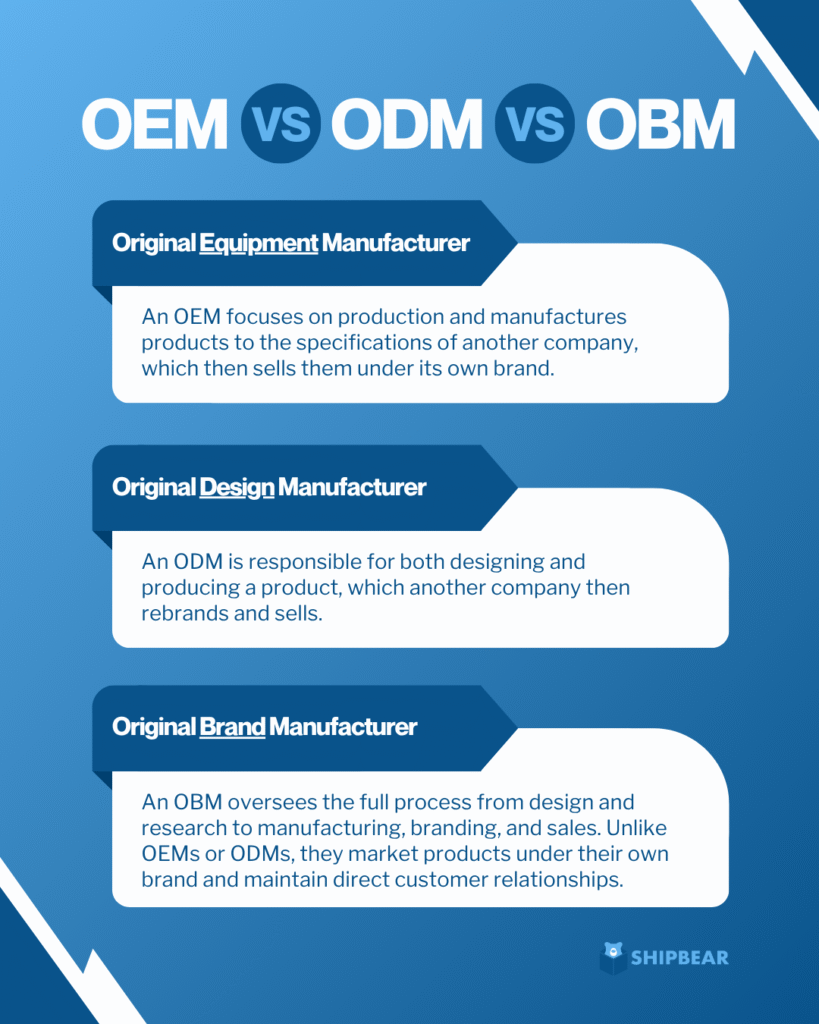
OEM — Original Equipment Manufacturer
What it means: A manufacturer designs and produces a product that other companies can rebrand and sell. The ODM owns the product design and development; clients buy the product as-is or request modest customizations (colors, logos, minor feature changes).
Typical relationship: Manufacturer (creates product designs) → Brand (buys product, rebrands and markets under its own label).
When used: When a company wants to market new products quickly without investing in in-house design, or to enter markets with standard product categories.
Advantages: Lower upfront design cost and faster time-to-market; benefits from manufacturer’s engineering and production expertise; reduced R&D burden.
Drawbacks: Less control over unique product differentiation; potential IP/shared design across multiple brands; limited scope for deep customization.
ODM (Original Design Manufacturer)
refers to a company that designs and manufactures products which are then branded and sold by another company. Unlike a contract manufacturer that produces to a buyer’s provided specifications, an ODM handles both product design and production, offering a turnkey solution from concept through manufacturing.
Design ownership: The ODM develops the product’s engineering, industrial design, and often the bill of materials. The contracting brand typically purchases the finished design and product, applying its own brand or slight customizations.
Manufacturing capability: ODMs maintain production facilities and quality control processes, enabling scalable manufacturing and supply chain management.
Faster time to market: By providing ready-made designs, ODMs reduce the brand’s development time and R&D investment.
Cost efficiency: Economies of scale and expertise in component sourcing and production reduce unit costs for client brands.
Customization options: Many ODMs offer varying degrees of customization—logo, colors, minor feature changes—while retaining core design and tooling.
Intellectual property (IP) considerations: Depending on contract terms, the ODM may retain design IP or transfer rights to the buyer. Clear agreements are essential to avoid future disputes.
Common industries: Electronics, consumer goods, household appliances, automotive components, and fashion/accessories
OBM — Original Brand Manufacturer
(often simply “Brand Owner”)
What it means: A company that owns the branded product and handles brand development, marketing, sales and often product strategy. An OBM may do design and manufacture in-house or outsource manufacturing to OEMs/ODMs, but the key is ownership of the brand sold to customers.
Typical relationship: Brand owner (OBM) controls branding, distribution, after-sales; manufacturing may be internal or contracted.
When used: When a company focuses on building brand equity, customer relationships, and distribution channels, regardless of who manufactures the product.
Advantages: Total control over brand positioning, pricing, and customer experience; can integrate supply chain partners to scale quickly.
Drawbacks: Responsibility for marketing, sales, warranty, and reputation; requires investment in brand-building and channel management.
Control of design: OEM (high, by brand) > ODM (low, by manufacturer) > OBM (varies; may own design or outsource).
Control of brand: OBM (high) = OEM (if brand owns product) > ODM (client brands a manufacturer’s design).
Time to market: ODM (fastest) > OEM (moderate) > OBM (depends on design and brand setup).
Typical use case: OEM for custom products where IP and differentiation matter; ODM for standardized products or quick product lines; OBM for companies focused on brand and customer-facing activities.

Industrial Design & Technical Drawings
Material & Component Selection
Prototype Creation & Refinement
Branding & Logo Placement Options
Colorways & Finish Customization
Packaging Design (Retail / Bulk / Premium)
Quality Control Requirements Setup
Mass Production Planning
Final Approval & Production Kick-off
For Alihsaan Holdings clients
We assess product strategy, market timing, IP requirements, and margin targets to recommend OEM, ODM, OBM or hybrid approaches and to structure supplier agreements, quality controls, and logistics accordingly.

“Appoint us Alihsaan Holdings and Let’s to convert your energy into assets”.